Wrestling first, at home
his accountThose first ones, the ones that are out of sport realistically because they're so dangerous — those are the ones I learned first, before learning freestyle and Greco-Roman. When I was doing wrestling in school, and living with wrestlers while in school and as an adult as well, they mostly at home would do things that weren't obviously for pointage and what not. A lot of spinal locks, neck pressures, illegal moves that you can't realistically do in sport, because it's not for points or pinning or anything like that. It's just for wrestling. Catch-style, submission first. That is where I started.
Martial arts before 15
his accountPrior to that, my sister and my cousin and I, we started Taekwondo and other styles like Kung Fu, and then I moved my way up into Judo and Jiu-Jitsu before I was 15. I was already doing those heavy handed wrestlings as a means of being able to build my lower technique and my upper body strength and technique, working out my core and what not, just to be able to know holds. You learn in different things. Even learning Aikido, being that of stylish moves and what not, is still incorporated — somewhat of like half of a percent — into mixed martial arts, because it is a close quarter combat fluidity: you may need that, and you need to know that, because it is also incorporated into other things.
Weapons
his accountI was even training in sword, sai, nunchucks, shurikens, ninja stars, darts — pretty much anything that you can name that they allowed me to have. I was really trying to make my way to one of the tournaments. I was really trying to get into nunchuck tournaments, because I really like the nunchucks as well as the sai. They're so up close and personal, with this versatile length attack depending upon what you're doing. And you can always throw them, as a last resort kind of thing. But stylistic more than anything. Then I moved my way up into both staffing and then archery, and then ended up doing small arms, mid-range, and then powerful long range kind of stuff.
Every style I could take on
his accountMy experience is that I took on every style that’s out there that I possibly could. Being aware of having hyperthymesia, whether studying a book or a video, I always took it into real life and did it in some form, some way. I took on P90X. I learned that you work out wherever you have that opportunity. I follow Chuck Norris rules — watched him on those QVC nights. Followed Van Damme. Followed Bruce Lee. Read all those books and went beyond just the nonsense of what is presented in movies — I took it to the actual real formalizations and professionalisms of who started it, how it came to be in its chronological histories, and why it is what it is today.
After my back was broken
his accountEventually, when I was 15 and my back was broken, that's when I started taking on Greco, or Greco-Roman wrestling, and freestyling for pointing, because the technicalities of it were a lot better on my spine. Once I got into the ring and stuff like that, that's when I got into Greco — it's about pointage and getting it onto that technicality side, just like Taekwondo.
Carte blanche
his accountIt wasn't just minor classes that a parent would put their kid into to have somebody babysit them. My parents and my grandparents allowed us to sign up for whatever we wanted — whether it be Boy Scouts, Eagle Scouts, volunteer works, building playgrounds, being part of city works and stuff like that, taking on wrestling. Whatever we wanted. It was carte blanche. We could just do whatever kind of thing, and it was kind of cool.
Within the 90s there was a lot of extreme activities going on — dangerous things, gang activities, terrorism, things like that — so programs were being put out, more than like DARE programs, which I was already signed up with. I ended up taking every single class that I possibly could that anybody would allow me to pay money for or utilize for free. I got to do a lot of pretty cool sophisticated stuff: running mazes, gauntlets, testing — not just physical testing, but putting devices together, learning how to deactivate or take on IEDs and things like that, and I even got into bomb defusals. I took on every point that I possibly could that the 90s afforded, before 9-11. And then when that hit, I additionally increased into cybersecurity, and then as well as different types of close quarter combats. I was working my way into learning counterterrorism, close quarter combating, martial arts, and just really, really getting into it before I even hit 18.
DARE
his accountI was really incorporated into the DARE program starting around like seven or eight years old. And they took me on ride-alongs. I got to go to a bunch of different things that I don't talk about. I got to see stuff in brief cases, go to presentations, seminars. Like, there was a lot of stuff, and it was pretty cool.
Thai fighting — the casino years
his accountWhen I worked in the casinos, starting at 18 years old, I started learning Thai fighting — specifically Thai kicking — from the martial arts presentations they put on at that casino. I got to know a lot of them and they taught me: how you go down and kick and swing downwards into the thigh, at that degree of that angle, just like a baseball bat, and how to keep your shin from splitting, fracturing out, or breaking altogether. I got to learn a lot of that type of stuff — the holds, not just the punches, but the values and the reasons of them, and their principalities.
The styles — brief histories and extremeness
reference notesReference notes compiled by Atlas — not Steven’s words. Brief histories and an extremeness rating for each style named on this page, kept separate from his account above. The rating runs 1–10 and is driven by what the rules allow: submissions, strikes, throws, and the injury profile that follows.
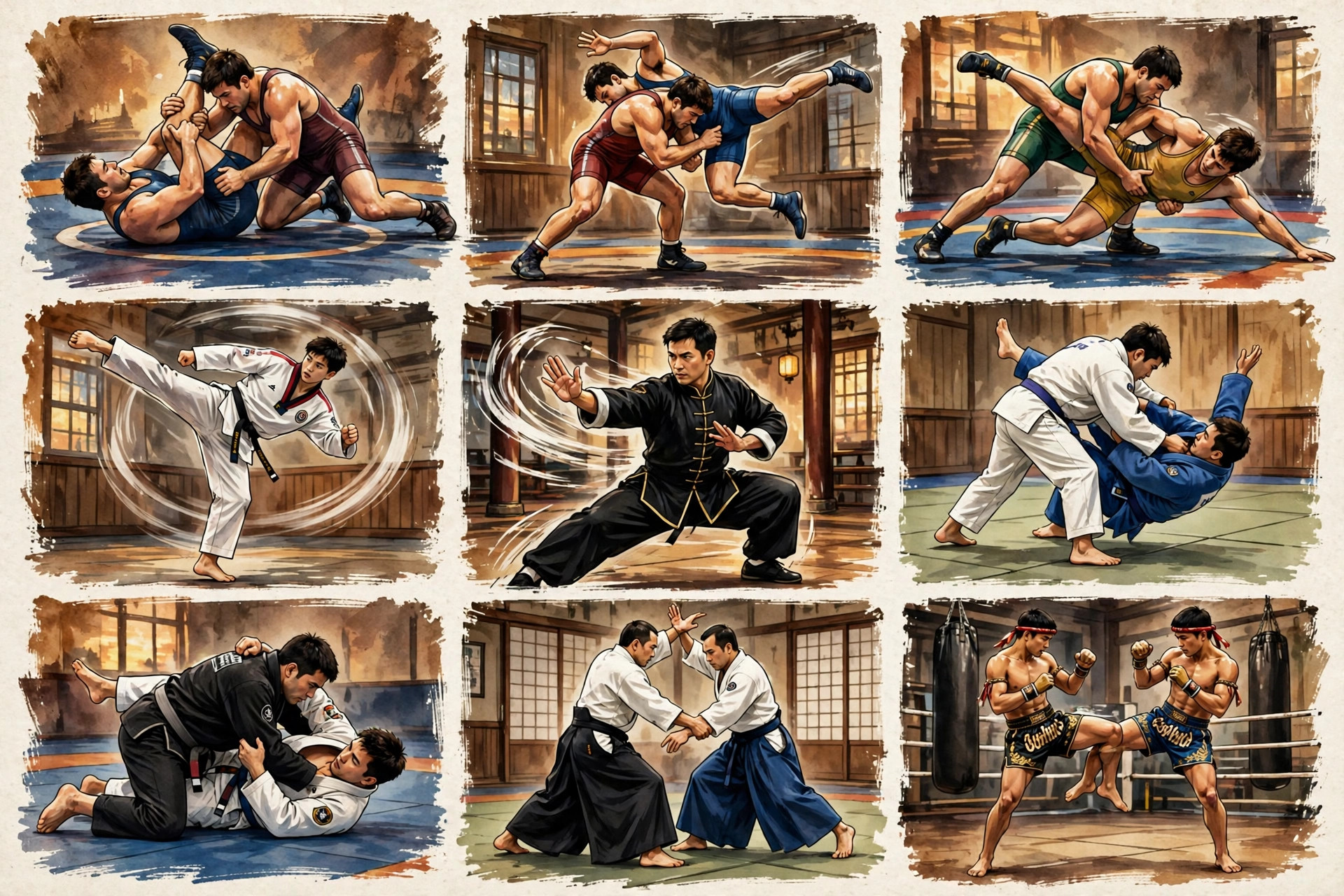
| Style | Brief history | Extremeness |
|---|---|---|
| Catch wrestling | Born in 19th-century Lancashire, England, as “catch-as-catch-can”: win by pin or by submission, with very few holds barred. It spread through carnivals and music halls in Britain and America and is an ancestor of both freestyle wrestling and professional wrestling. | 9 / 10 — Submissions are the point — joint locks, neck cranks, and spinal pressure all legal, historically with minimal restriction. |
| Greco-Roman wrestling | Formalised in 19th-century France and named in honour of the ancient Greek and Roman world. An Olympic sport from the first modern Games at Athens in 1896. Grips below the waist are banned, and legs may not be used to trip or hold — upper-body throws decide it. | 6 / 10 — No submissions and no leg attacks, but matches turn on high-amplitude throws onto the mat. |
| Freestyle wrestling | Developed out of catch-as-catch-can in Britain and the United States and Olympic since St. Louis 1904. Leg attacks, trips, and turns are all legal alongside upper-body work; a bout is won by pin or by points for takedowns, exposures, and reversals. | 6 / 10 — Full takedown game including leg shots, plus scored back exposure — hard impacts, but no submissions or strikes. |
| Taekwondo | Korea’s national art, formalised in the 1950s out of older Korean kicking traditions and wartime karate influence; the name was adopted in 1955. The WT federation followed in 1973 and it became a full Olympic sport at Sydney 2000. Built around fast, high, spinning kicks, scored electronically on body and head protectors. | 5 / 10 — Full-contact kicks to the head land in competition, but padded, point-scored, and with no grappling. |
| Kung Fu | An umbrella term for centuries of Chinese martial arts — the Shaolin Temple in Henan is the most famous source, though hundreds of family and regional systems exist. Striking, weapons, and forms (taolu) sit side by side; the modern sport of wushu standardised forms in 20th-century China, with sanda as its full-contact fighting arm. | 5 / 10 — Varies by system: forms practice is low-contact, while sanda adds full-contact strikes and throws. |
| Judo | Founded in 1882 in Tokyo by Kanō Jigorō, who refined older jūjutsu schools into the Kodokan system — maximum efficiency, mutual benefit. Olympic since Tokyo 1964. Throws, hold-downs, chokes, and armbars, practised live against full resistance in randori. | 7 / 10 — High-amplitude throws onto the mat plus chokes and armbars, trained and competed at full resistance. |
| Jiu-Jitsu | Japanese jūjutsu was the samurai’s grappling art for when weapons were lost. In the 1910s–20s, Mitsuyo Maeda carried it to Brazil, where the Gracie family developed it into Brazilian jiu-jitsu — ground fighting built on position, leverage, and submissions from the guard. | 6 / 10 — Joint locks and chokes applied at full resistance, but a tap ends everything and strikes are absent. |
| Aikido | Created in Japan by Morihei Ueshiba, developed from the 1920s onward out of Daitō-ryū aiki-jūjutsu. Circular blending movements turn an attack into joint locks and throws; Ueshiba deliberately removed competition, so practice is cooperative by design. | 3 / 10 — Techniques are real joint locks and throws, but applied to a compliant partner with no live sparring or contests. |
| Muay Thai | Thailand’s national art, descended from Siamese battlefield fighting (muay boran) and codified as a ring sport in the early 20th century with gloves, rounds, and a ring. Called the art of eight limbs: fists, elbows, knees, and shins, with an extended clinch game. | 9 / 10 — Full-contact everything — elbows and knees included, at close range, over full rounds; damage accumulates fast. |
Disclaimer: This page is a continuation of knowledge already gained across a lifetime of training, set down in dictation as part of my recovery from amnesia. It is an inventory of what was learned, in my own words, recorded so that it is not lost again.
Steven’s own words and account, from his conversation with Atlas, Nov 25, 2026.